Cortisol Tracking Apps: iPhone, Apple Watch & Testing
Choosing a cortisol tracking app? Compare wearable stress tracking with hormone tests, see what Cortisol+ does on iPhone, and understand free versus paid options.
Updated September 17, 2026 · By Cortisol+ Editorial
To track actual cortisol, you need an appropriate hormone test and a plan for interpreting it. To track everyday stress and recovery, record sleep, perceived stress and available wearable readings. These are different activities: a journal or an Apple Watch app cannot tell you your cortisol concentration.
This guide is published by the Cortisol+ team. We make a wearable wellness app, not a cortisol test. It is educational information, not a personalized testing recommendation.
How can I better track my cortisol?
Start by deciding what you want to learn. If you have a medical concern or an abnormal test result, ask your clinician which test, collection time and follow-up make sense. If you want to understand your daily routine, use a consistent observation log. Keep laboratory results separate from app scores, and avoid interpreting a change in sleep or HRV as proof that a hormone changed.
| Your question | Useful approach | What it cannot establish |
|---|---|---|
| What is my cortisol level? | Appropriately selected blood, saliva or urine testing | A result does not explain its cause without clinical context |
| What changes around stressful days? | A dated sleep, routine and perceived-stress journal | The journal does not measure cortisol |
| How do my wearable readings vary? | Compare the same device and metric over comparable periods | HRV and wellness scores are not hormone concentrations |
MedlinePlus explains the types of cortisol tests and why collection timing matters. Our at-home cortisol collection checklist explains the questions to ask before ordering or collecting a sample.
What does a cortisol tracking app actually track?
A cortisol tracking app may organize hormone-test results or interpret wearable stress signals. Check which one it does. Cortisol+ is an iPhone wellness app that uses permitted Apple Health data to help you review HRV, sleep and recovery-related patterns. Its score is not a blood, saliva or urine cortisol measurement.
| Approach | What to look for | Where to start |
|---|---|---|
| Wearable stress app | Named inputs, readable history, missing-data explanations and subscription terms | Compare documented Apple Watch stress-app features |
| Laboratory result record | Sample type, collection time, units and the testing lab's reference interval | Understand cortisol testing |
| Daily observation log | A consistent place to record sleep, routine and how you feel | Use the free stress and sleep journal |
Which cortisol tracking app should I choose for iPhone?
Choose according to your goal. If you want to explore Apple Health readings with an explanation of a wellness score, consider Cortisol+. If you need an actual cortisol result, an HRV app cannot answer that question. Review the Cortisol+ methodology and app walkthrough before deciding whether the presentation fits your routine.
View Cortisol+ on the App Store. The download is free; analysis requires a subscription or an eligible trial. Check the compatibility information and current offer before subscribing.
Is there a free cortisol tracking app?
For a free starting point, review available wearable readings in Apple Health and keep an observation journal. Neither measures cortisol. Free to download also does not mean every analysis feature is free: Cortisol+ requires a subscription or eligible trial for analysis. Compare the ongoing price, trial eligibility and included features shown in each app.
A practical daily tracking workflow
- Record the date and sleep window. Note bedtime, wake time and interruptions in your own words.
- Add how you felt. Use a consistent personal description or scale for perceived stress and energy. This is a self-report, not a diagnosis.
- Record relevant context. Note changes in exercise, caffeine timing, alcohol, illness or routine. Do not change medication to improve a graph.
- Check available wearable samples. Confirm the source, units and timestamps. Missing data is not a low reading.
- Review patterns without assigning a cause. “These changed together” is a useful observation to investigate; it is not proof of a cortisol change.
Use the free seven-day stress and sleep journal as a starting format. Seven days is an organizational choice, not a validated cortisol-testing schedule.
What should I record alongside a cortisol test?
Keep the laboratory report, units, reference range, sample type and collection date/time together. Tell the ordering clinician about medicines and relevant changes in your routine. Follow the collection instructions you were given, rather than a generic online schedule. Do not compare a saliva result directly with a blood result or assume results from different laboratories use identical ranges.
How do I compare my app score with a cortisol test?
Keep them in separate records; do not convert one into the other. A cortisol result belongs with its sample type, collection time, units and laboratory reference interval. A wearable score belongs with its app, underlying readings and time window. Our practical recommendation is to review the context together without assuming the numbers should match.
- Laboratory record: retain the original report and discuss interpretation with the clinician. MedlinePlus describes the different sample methods and preparation requirements.
- Wearable record: note which readings contributed and whether any were missing. The Cortisol+ methodology explains our model rather than a hormone assay.
- Personal observation: record how you felt separately. NCCIH distinguishes research on self-reported stress from physiological measures; a calmer feeling does not provide a cortisol concentration.
For example, a better app score after a restful night is an observation about that model's inputs. It does not establish that a saliva result would be lower. This is an explanation of how to organize information, not a result from a clinical comparison of Cortisol+ and testing.
Can I track cortisol without a test?
You can track stress-related observations without a test, but you cannot confirm your cortisol level from them. Apple Watch records signals such as heart rate, HRV and sleep; it does not directly measure cortisol. An app can interpret those inputs, but that interpretation needs its own evidence and limitations.
Where Cortisol+ fits
Cortisol+ helps you review available wearable signals and the factors behind its wellness score. Read the methodology, inspect the contributing records, and compare similar periods. Clinical accuracy against laboratory cortisol testing has not been established. The app cannot decide whether testing is needed or confirm that a habit lowered cortisol.
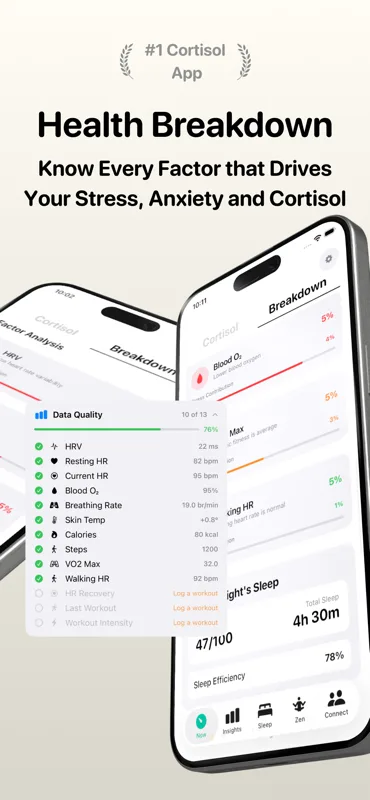
The app is free to download; analysis requires a subscription or an eligible trial. Review current terms in the app.
Paid creator video · Kindra
Tracking stress, sleep and recovery at home
Kindra introduces the app’s wearable-data views and guided breathing. Use the video as a product introduction alongside the daily observation workflow above, rather than as a guide to diagnosing cortisol levels.
Fatigue, hair loss and changes in body shape can have many causes; the opening symptoms cannot diagnose high cortisol. Cortisol+ does not measure hormone levels or replace testing. Its stress and biological-age scores are estimates. This is paid promotion, not clinical evidence.
Watch this Short on YouTube · Read the methodology
Download on the App StoreFree to download. Analysis requires a subscription or an eligible trial. Playback is provided by YouTube.
How often should I test cortisol?
There is no universal consumer testing frequency. The schedule depends on why a clinician is testing and which method is used. Repeated tests without a defined question can be difficult to interpret. Persistent or concerning symptoms deserve clinical assessment rather than repeated app checks.
What if my goal is to lower cortisol?
First distinguish everyday stress management from treating a diagnosed hormone disorder. Our guide to lowering cortisol levels and managing stress naturally explains practical habits, evidence limits and when medical care matters.